

Top 7 High-End RV Tech Gadgets for Modern Full-Time Travelers
Tire Pressure Monitoring Systems (TPMS) for Real-Time Safety
Among RV tech gadgets that deliver immediate safety returns, a quality TPMS is hard to beat. Real-time pressure and temperature data help you catch slow leaks, rapid deflation, or overheating before they escalate into tire damage or blowouts. For full-time RV technology users logging thousands of miles, that early warning can protect wheels, fenders, and schedules alike.
When choosing premium RV gear in this category, prioritize range, durability, and configurability. Long rigs, fifth wheels, and motorhome + toad setups benefit from systems with signal repeaters, multi-axle support, and clear, customizable alerts. Decide whether you want a dedicated color display, an app-based interface via Bluetooth, or both for redundancy many of the best RV electronics now offer dual-display options.
Key features to look for:
- Customizable high/low PSI and temperature thresholds per axle or tire position
- Signal repeater/booster for rigs over ~35–40 feet or when towing a vehicle
- Flow-through sensors (for metal valve stems) vs. lightweight cap sensors for rubber stems
- User-replaceable sensor batteries or long-life sealed internals
- Straightforward pairing with auto-scan and clear labeling for each wheel position
- Water-resistant, vibration-rated sensors with anti-theft collars
Set your baseline “cold” tire pressures using axle weights and manufacturer load/inflation tables, then program alert ranges (commonly around 10–15% low and 20–25% high, per your tire specs). Mount the repeater near the rear of the coach or trailer to improve reception, especially on triple-axle or toy-hauler layouts. If you flat-tow, add sensors to the toad and trailer spare so you don’t miss a problem that’s out of sight.
TechnoRV’s team of experienced travelers curates advanced RV devices and supports setup, from selecting sensor types to dialing in thresholds for your specific tires and load. Explore their vetted TPMS for RVs to build a safer, more connected road setup alongside other RV tech gadgets and RV connectivity solutions.
Mobile Internet Routers for Reliable Connectivity
For full-time travelers, dependable internet is no longer optional it’s the backbone of work, navigation, and entertainment on the road. Dedicated mobile internet routers stand out among RV tech gadgets because they’re built for constant movement and variable signal conditions, far outperforming basic phone hotspots. The best RV electronics in this category combine multiple connections into one secure, manageable network that all your devices can share.
Look for routers that support modern 5G or advanced LTE with carrier aggregation to boost speeds from weak towers. Dual SIM or multi-modem options enable automatic failover between carriers, while Wi-Fi-as-WAN lets you safely use campground Wi-Fi as a backup. Advanced RV devices add features like load balancing, quality of service for video calls, VPN pass-through, and enterprise-grade firewalls to keep your data protected.
Key features to prioritize in RV connectivity solutions:
- 5G or high-category LTE modem (Cat 12+), with 2x2 or 4x4 MIMO
- External antenna ports and roof-mount MIMO antennas for range and stability
- Dual SIM or multi-WAN failover (cellular, Wi-Fi-as-WAN, Ethernet)
- Robust security: WPA3, firewall, guest networks, VPN support
- Remote management and usage monitoring to avoid data overages
- 12V power compatibility and rugged housings for mobile environments
In real world use, these routers smooth out the connectivity bumps you feel moving between boondocking sites, interstates, and crowded campgrounds. When cellular dips, the system can shift to a secondary carrier or safely leverage park Wi-Fi without reconfiguring all your devices. The result is reliable streaming, crystal clear video calls, quick map updates, and consistent schoolwork for kids hallmarks of premium RV gear.
A solid router also complements RV-specific navigation units by providing continuous WiFi for live traffic, weather, and map updates; see TechnoRV’s curated RV GPS Navigation options to round out your cockpit tech. TechnoRV’s team of full-time travelers helps match routers, antennas, and cellular boosters to your carriers and travel style, and provides setup guidance that reduces trial-and-error.
Cellular Signal Boosters for Extended Coverage
For many full-time travelers, cellular data is the backbone of work, navigation, and streaming. Among RV tech gadgets, a quality cellular booster can turn a flickering one-bar signal into usable data and dependable voice calls. These advanced RV devices use a roof-mounted antenna to capture weak outside signal, amplify it within FCC limits, then rebroadcast it inside your rig for phones and mobile hotspots across major U.S. carriers.
Match the booster to how you travel. The weBoost Drive Reach RV is built for in-motion use with up to 50 dB of gain, while the Destination RV offers up to 65 dB for parked camping where you can’t afford to miss a call or upload. They boost 4G LTE and some low-band 5G, but won’t amplify mid-band 5G (like C-band or n41). A booster won’t create signal from nothing; it needs at least a faint donor signal—still, it’s among the best RV electronics for fringe coverage.
If you rely on a cellular router with external MIMO antennas, prioritize a quality roof MIMO antenna for top speeds; use the booster to stabilize a single smartphone or hotspot when signals are marginal. Expect the biggest wins in upload reliability, video calls, and text/call performance rather than peak download speed. For RV connectivity solutions, keep your device within a few feet of the interior antenna for best results.
Installation tips for premium RV gear:
- Mount the exterior antenna high and clear of obstructions; with directional antennas (Destination RV), aim toward the nearest tower using a reliable tower-locator app.
- Maintain generous separation and/or structural barriers between outside and inside antennas to prevent oscillation.
- Use the shortest coax runs possible and avoid sharp bends to minimize cable loss.
- Power from a clean 12V source and secure cables to handle vibration and weather.
- Place the interior antenna near your primary device or workstation.
Advanced GPS Navigation Systems for RVs
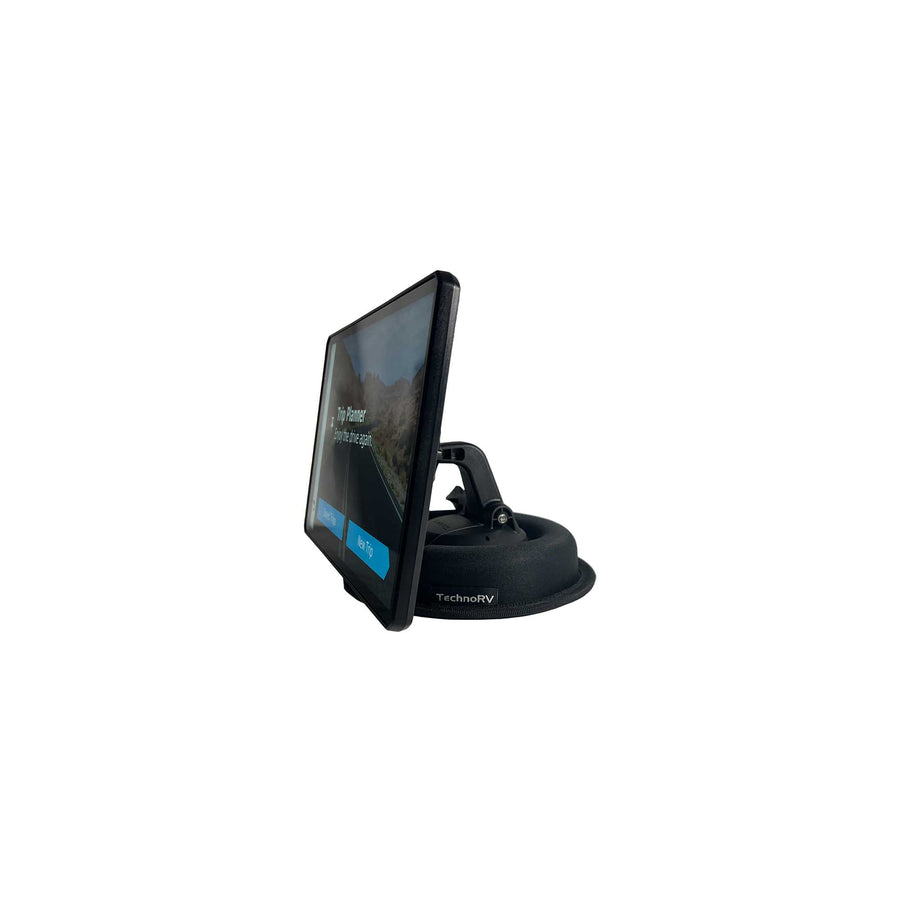
For full-time travelers, an RV-specific GPS is one of the RV tech gadgets that delivers immediate, everyday value. Unlike car units, these advanced RV devices build routes around your rig’s profile height, weight, length, and propane status so you avoid low clearances, tight switchbacks, and restricted tunnels. Models like the Garmin RV 895 and RV 1095 add large, bright displays and split screen views that are easy to read from the cockpit, plus voice control to keep your hands on the wheel.
Key capabilities to look for in the best RV electronics include:
- Custom routing by vehicle dimensions and weight, with warnings for steep grades, sharp curves, and weight-restricted bridges
- Propane restriction alerts and low-clearance avoidance for fifth wheels and Class A rigs
- Robust POI databases (KOA, iOverlander, Ultimate Public Campgrounds, and fuel stations with diesel lanes)
- Wireless backup camera compatibility (e.g., Garmin BC series) and lane guidance/junction views
- Offline North America maps with Wi‑Fi updates and trip planning tools for multi-stop routes
- Real-time traffic and incident alerts via smartphone or hotspot connection
Consider a 40-foot Class A towing a Jeep with a 13' height: an RV-focused unit will flag a 12'10" bridge ahead, reroute you before the last safe exit, and suggest diesel-friendly fuel stops along the detour. When plans change, you can add a campground on the fly and still get arrival time, elevation, and grade warnings. This is full-time RV technology that reduces stress day after day.
For dependable live traffic data and app-based updates on the road, pair your GPS with solid RV connectivity solutions such as a cellular router; many full-timers use Pepwave routers as part of a premium RV gear setup. TechnoRV curates RV-only navigation units and backs them with setup guides and real-world support from experienced travelers, so you get the right device configured correctly before your next trip.
Electrical Surge Protection and Soft Starters
Campground power can be unpredictable voltage can sag on hot afternoons, pedestals may be miswired, and lightning or utility events can cause damaging spikes. For anyone relying on premium RV gear like inverter/chargers, residential fridges, and control boards, a quality Electrical Management System (EMS) surge protector is one of the most critical RV tech gadgets you can own. It’s core to full-time RV technology because it prevents expensive failures before they happen and keeps your rig safely powered in real-world conditions.
A true EMS goes beyond basic surge absorption. It continuously monitors voltage, frequency, open ground/neutral, and reverse polarity, and it will automatically cut power if levels fall below roughly 104V or rise above 132V, then restore service once conditions normalize. Look for high joule ratings, weatherproof housings, and Bluetooth or remote displays to see errors without stepping outside. Many travelers prefer portable surge protection for flexibility between 30A and 50A sites and the ability to test a pedestal before connecting the coach.
Soft starters complement EMS devices by reducing the compressor’s inrush current when your rooftop A/C kicks on often by 65–75% with leading designs. That lower startup draw reduces light dimming, helps an RV run one or even two A/C units more comfortably on 30A service, and can make a small inverter generator or solar-hybrid system far more usable in hot weather. It also eases mechanical strain on the compressor, which can extend equipment life and lower overall noise.
What to look for when choosing the best RV electronics in this category:
- EMS sized for 30A TT-30 or 50A 14-50 service, with automatic pedestal testing and clear error codes.
- Replaceable surge modules, UL/ETL listings, and a lockable, weatherproof case.
- Soft starter compatibility with your specific A/C model and a guided self-learn commissioning process.
- Remote/Bluetooth monitoring so you can track trends and diagnose issues quickly handy alongside other advanced RV devices and RV connectivity solutions.
Smart Water Filtration Systems
Among RV tech gadgets that actually improve daily life, smart water filtration systems are near the top. Campground water quality can swing from crystal clear to sediment-heavy, chlorinated, or even biologically suspect. A modern setup combines multi-stage filtration for taste and sediment with point-of-use purification and simple monitoring so you always know you’re drinking safe, great-tasting water.
For portable whole RV protection, look for robust three-stage canister systems with a sediment prefilter, catalytic carbon for chemicals and VOCs, and a submicron final stage (≤0.2 μm absolute) to capture fine particulates. Pairing that with an under-sink UV‑LED purifier at the galley faucet delivers an extra microbiological safety net without the water waste of RO. Add a washable spin-down prefilter when boondocking or at older parks with heavy rust and sand to extend cartridge life.
What to look for in premium RV gear:
- Micron rating and certifications: NSF/ANSI 42 for taste/odor and chlorine, 53 for health-related contaminants; for microbiological claims, look for systems validated to NSF/ANSI P231 or UV systems designed to NSF/ANSI 55 guidelines.
- Flow and pressure: Aim for 3–5 GPM with minimal pressure drop so showers don’t suffer; use a quality regulator set around 45–55 psi to protect plumbing and filters.
- Cartridge lifespan and availability: Clear gallon ratings, easy-sourced replacements, and tool-free changes minimize downtime on long trips.
- Cold-weather and serviceability: Quick-drain ports, sturdy frames, and quick-connect hoses make winterizing and weekly moves faster and cleaner.
- Smart monitoring and safety: Inline pressure gauges, filter-life indicators, and app-based leak sensors under sinks provide early warnings before damage occurs.
TechnoRV curates advanced RV devices like submicron multi-stage filters, UV‑LED purifiers, pressure regulators, and dedicated potable-water hose kits, all tested by full-time travelers. Their expert support can help you size a system for full-time RV technology needs and match cartridges to your water sources. While you’re upgrading essential systems, consider complementary safety add-ons such as GasStop propane safety to round out your rig’s protection alongside the best RV electronics and filtration.
Propane Safety Monitoring Devices
Propane powers cooking, heating, and hot water, but a small leak can escalate quickly in a confined RV. For serious travelers, propane monitoring belongs alongside the other RV tech gadgets you rely on daily. As full-time RV technology advances, today’s systems merge detection, level tracking, and emergency shutoff for layered protection.
A robust setup typically combines a hardwired LP gas alarm, Bluetooth tank sensors, and an in-line emergency shutoff/pressure gauge. This trio sits among the best RV electronics for safety: detectors like Safe-T-Alert monitor for explosive gas 24/7, Mopeka Pro ultrasonic sensors display accurate tank levels on your phone, and GasStop can instantly cut flow during a hose rupture while enabling a simple leak test. Together, they reduce risk and eliminate guesswork about remaining fuel.
When evaluating premium RV gear, check for UL/CSA certifications, low false-alarm rates, and clear end-of-life timelines for replaceable alarms. Confirm compatibility for DOT cylinders versus ASME tanks, magnet versus collar mounts, and whether a Bluetooth-to-Wi-Fi bridge allows cloud alerts useful when you’re off-site or tying into broader RV connectivity solutions. App features like configurable low-level thresholds, multi-tank dashboards, and shared access streamline day-to-day use.
- Boondocking in freezing temps: get early low-level alerts before 3 a.m. outages.
- After swapping cylinders: use pressure-decay testing to spot slow leaks fast.
- Away from camp with pets inside: receive phone alerts if LP accumulates.
- Long travel days: track daily consumption to plan reliable refill stops.
Install LP detectors low near the floor propane is heavier than air and test alarms monthly. Vacuum detector grills, replace LP/CO units every 5–7 years per manufacturer guidance, and use LP-rated thread sealant on fittings. After any work on the system, secure pigtails and perform a leak-down test before opening valves fully.
TechnoRV curates Bluetooth tank monitors, emergency shutoff valves, and RV-specific LP alarms vetted by full-time travelers. Their team can help you pick the right sensor for steel or ASME tanks, pair devices, and set smart alert thresholds so your advanced RV devices protect you without hassle.
Conclusion: Investing in Quality RV Technology
Choosing quality RV tech gadgets pays off in safety, uptime, and comfort. For full-time RV technology, prioritize durability, support, and how well gear works together not just new features. Premium RV gear with proven components and reliable firmware reduces failures in remote or extreme conditions.
Real-world returns are tangible. A TPMS that tracks pressure and temperature warns early about slow leaks, preventing blowouts and body damage. An electrical management system (EMS) safeguards against low/high voltage, miswired pedestals, and surges. A soft starter lowers A/C inrush so a 13.5k–15k BTU unit can run on 30A or a small inverter generator advanced RV devices that quickly pay for themselves.
Connectivity and navigation deserve the same rigor. A multi-WAN LTE/5G router with dual SIM and external MIMO antennas provides resilient RV connectivity solutions; pair it with carrier-diverse plans, and use a booster only to clean up weak signal. An RV-specific GPS that accounts for height, weight, and propane restrictions avoids low clearances. Two or three-stage water filtration (sediment + carbon + optional hollow-fiber) plus dependable propane/CO alarms protect health and appliances.
When evaluating options, look for:
- Recognized certifications (UL, CSA, FCC) and clear surge/temperature ratings.
- Frequent firmware updates and local admin access.
- Replaceable parts (e.g., TPMS sensor batteries) and available spares.
- Documented power draw, cabling, and mounting options.
- Warranty length, return policy, and responsive human support.
- Integration with apps/dashboards and remote monitoring.
TechnoRV curates and tests solutions on the road, then backs them with setup guides and expert support from experienced travelers. Their lineup makes it easier to choose the best RV electronics from TPMS and EMS to routers and antennas for your rig. Invest once in vetted RV tech gadgets and enjoy safer miles with fewer surprises.
RV FuelSaver Program
Introducing the RV FuelSaver Program to bring you deep discounts on diesel nationwide!
Leave a comment